
.jpg)
Case Analysis
Solution for improving foreign objects in the backlight of TFT display modules
In the composition of a TFT module, the backlight is a very important component. It emits light through LEDs, and the light guide plate converts the point light source into a surface light source. In order to achieve better uniformity and higher brightness, films such as brightness enhancement films and reflective films are usually added.
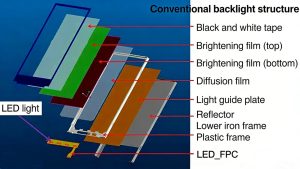
In LCM module manufacturing plants, backlights have the highest defect rate and are the most difficult to improve. The most common problem in backlight assembly is foreign matter in the backlight. Common backlight foreign matter problems are divided into two types: foreign matter in the assembly of the backlight and the lower polarizer, and foreign matter inside the backlight film.
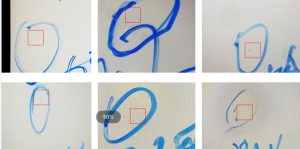
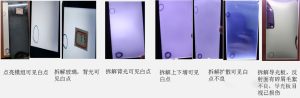
Solution for improving assembly foreign matter between backlight and lower polarizer:
| Serial Number | Risk level | Improvement measures |
| 1 | High | Each blister pack with backlighting needs to be covered with a large protective film to prevent dust.
|
| 2 | Low | Backlit incoming material inspection adds ion wind snake blowing to prevent dust falling.
|
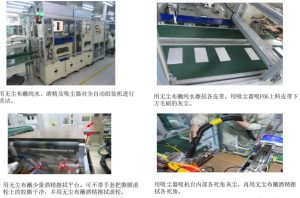
| 3 | Middle | Daily cleaning of the backlight assembly machine: Wipe the conveyor belt with a lint-free cloth and pure water; clean the brushes under the skin with a vacuum cleaner; wipe the film-peeling platform and film-peeling rollers with a lint-free cloth and alcohol to remove residual adhesive; clean the dust from the air pipes and wiring surfaces inside the equipment with a vacuum cleaner; and wipe hard-to-reach corners with a lint-free cloth and alcohol.
|
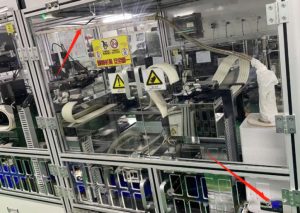
| 4 | High | Humidification is added inside the backlight assembly machine to control the humidity at 70%.
|
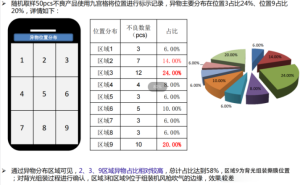
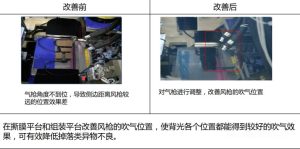
| 5 | High | The nine-square grid analysis area is used to adjust the initial angle and area of the ion wind snake according to each project to ensure that the entire backlight can be blown. FOG film should be cleaned of dirt and grime on small surfaces with alcohol before being uploaded.
|
| 6 | Middle | The viscosity of the backlight black adhesive is adjusted based on the dyne value of the lower polarizer surface. Too low a viscosity allows dust to easily enter, while too high a viscosity causes yellowing at the edges of the LCM display. For lenses with a dyne value ≤ 22, the backlight black adhesive viscosity is 1600; for lenses with a dyne value > 22, the corresponding backlight black adhesive viscosity is 850, and for the optical element, it is 500 for easy disassembly. |
| 7 | Middle | The upper brightening material should be made of anti-small ball material to avoid scratches and white marks caused by foreign objects between it and the lower polarizer. |
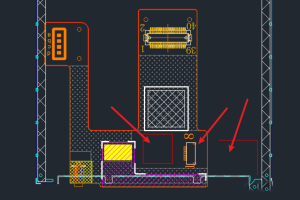
| 8 | High | The key point regarding the gap between the backlight and the housing of the LCM is to confirm the length, width, and height gaps between the components and the housing after the FPC is bonded to the backlight. The length, width, and height gaps should all be ≥0.5mm. Adjust the gaps in each direction appropriately based on the housing deformation and the offset dimensions of the FPC bonding.
|
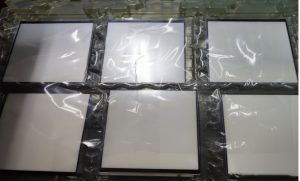
The following are solutions to improve the problem of foreign matter inside the backlight film:
| Serial Number | Risk level | Improvement measures |
| 1 | High | Backlight film materials should be selected based on their compressive strength, resistance to microsphere brightening, and resistance to diffusion of soft particles in high-haze conditions. Silver has better compressive strength than white reflector. |
| 2 | High | Cleanliness control of all components within the backlight supplier: Vibration of the glue frame for 30 minutes at 50Hz; ultrasonic cleaning of the glue frame for 12 minutes; using utility knife blades instead of round blades for slitting to ensure sharpness and prevent burrs; replacing the blade every 3 rolls; using black glue to clean the slitting material; applying dust pads or white tape to the sides before production, followed by freezing at -10℃ for 2 hours to reduce static electricity and identify components; humidifying the backlight lamination equipment to maintain 70% humidity; vacuum adsorption and luminescence rotation inspection; after backlight assembly, all components undergo continuous vibrating at 180-220 rpm for 2 hours; and a full vacuum adsorption and luminescence rotation inspection.
|
| 3 | High | 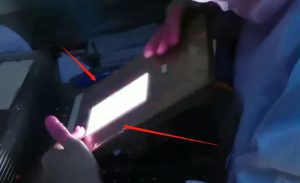
Establish a comparative library of foreign matter for spectral analysis of different models, and identify the source of foreign matter by region, layer, spectrum, and composition.
|
| 4 | High | LCM manufacturers conduct a series of inspections on incoming backlight materials, including a running vibration test at 180-220 rpm for 2 hours, a vacuum adsorption and light-emitting rotation inspection, and an IQC (Independent Quality Control) spot check at 70°C for 2 hours to confirm whether the backlight film material is arching. |
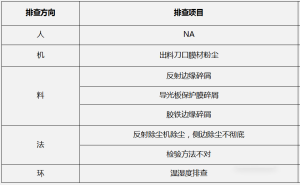
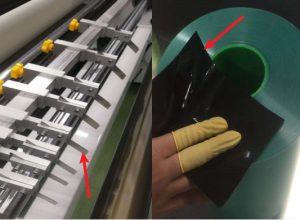
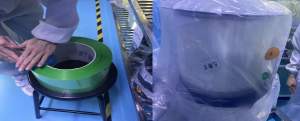
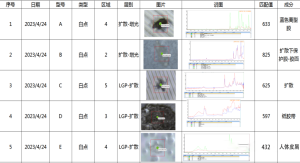
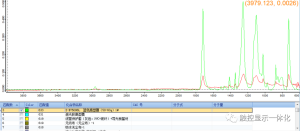
Improving LCM backlight foreign matter is a continuous and gradual process, and the root causes of problems will vary from project to project and batch to batch. Further investigation and confirmation must be carried out step by step according to the improvement plan above. Spectral analysis and comparison with the foreign matter library is a very useful tool and method for analyzing foreign matter white spot defects. Foreign matter lint defects in the touch film assembly can be analyzed in the same way as above.