.jpg)
Case Analysis
Various reasons for short circuits in the silver paste circuit of the touch module.
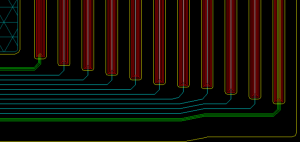
In the production process of touch sensors, defects such as dark breaks and short circuits after laser etching of silver paste lines are very easy to occur. Moreover, the defect rate is unstable for each batch or each time period, and the functional yield fluctuates. The dark breaks and short circuits after laser etching of silver paste lines are more obvious when viewed from the back of the material.
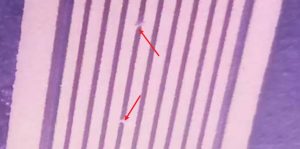
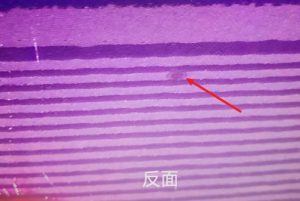
Ⅰ.Direct Causes of Dark Fractures in Laser Etching of Silver Paste Circuits: After the printed silver paste circuits have dried, if certain areas are too thin or have holes, dark fractures are likely to occur after laser etching under the same conditions. These fractures can then lead to touch channel malfunctions during subsequent processes or transportation.
Ⅱ. Various Root Causes of Dark Fractures in Laser Etching of Silver Paste Circuits
| Serial Number | Risk level | Improvement measures |
| 1 | Silver paste thickness <5um | For a 350-mesh screen, the thickness of the photosensitive emulsion on the screen contacting the ITO film must be controlled to ≥15µm, and the thickness of the photosensitive emulsion on the screen contacting the squeegee surface must be controlled to 2-3µm. This is to avoid excessively thick photosensitive emulsion on the squeegee surface, which can lead to difficulty in ink application during silver paste printing and uneven pigment distribution within the silver paste lines. |
| 2 | Silver particle size <0.3um | Replacing the silver particle size with 1/60th of the laser spot diameter, generally controlling the silver particle size to 0.5µm, such as Betterley’s 2880E silver paste, is quite suitable. |
| 3 | Laser etching parameters for fine line mismatch | DOE verification was performed on the number of laser etching passes, etching energy, etching speed, and corner delay. The number of defects per large sheet (short circuits, open circuits, and burst points) was statistically analyzed. DOE Taguchi design was used to obtain optimal values. For traces with a Y-axis spacing greater than 0.08mm, the laser etching passes were generally 5. Burst points on the laser traces can cause dark breaks in the silver paste traces. When multiple laser lines are split in the same channel, a “multi-line” layer needs to be added and the laser etching parameters readjusted. Laser trace design graphics should avoid perpendicularity and require chamfering (C0.05). For different laser etching equipment, it was defined which equipment can be used for fine-line etching. A green light source was used for inspection after laser etching. |
| 4 | Silver paste line network version partial area blockage network | Blockage in certain areas of the silver paste screen (FFU printing speed 950 rpm, dust measured on the printing press) can cause pinpoint air bubbles in these areas after silver paste factoring. After ink overflow, the silver paste thickness in these areas is thinner, making them prone to bursting and dark breaks after laser etching. This defect can be identified by comparing the location of the defect with the blocked areas on the silver paste screen (a fixed area). To prevent this, the screen should be thoroughly cleaned and dried with an air gun even after the workday ends. Before each screen setup, a check should be performed at the printing press for any screen blockages or punctures. For products with punctures, avoid wiping and manage the process carefully to prevent ITO damage or contamination. |